Sunday, 17 March 2013

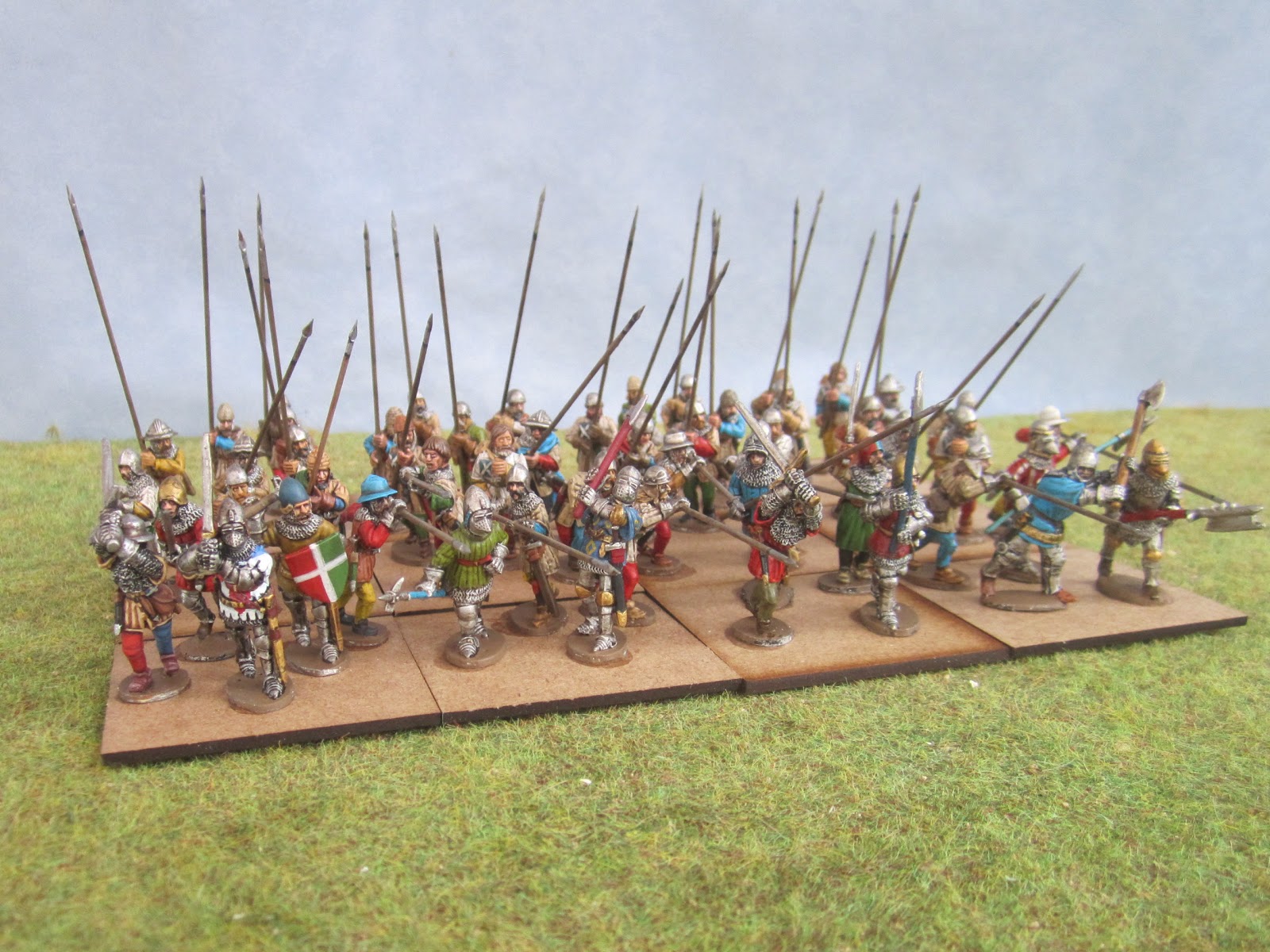
Scots for Cravant - WIP


I’m making modest progress on a number of fronts, so this is an update on prep for Cravant game, this time on one of the essential elements - more Scots.


The French army at Cravant was effectively a Franco-Scots force, with the Scottish mercenaries potentially comprising around half of the total men. This created a need to supplement the modest Scots contingent that I already have. Since amassing my HYW armies, Claymore Castings figures have arrived on the market, and so I decided to use these. Although the dress and armour is of a slightly earlier period (circa 1400) they are lovely sculpts and so this allows me to turn a blind eye to the minor anachronisms of ‘wrong period’ – something which I expect most others outside of ancients & medievals can’t so easily get away with. A couple of Perry men at arms have snuck their way in too.

I’d also been remiss in not having painted up any Paul Hicks designed figures before. The only disappointment is that, as deadlines need to be met, I have had to go the way of the dip to get enough figures done, which means that I’ve not had the opportunity to do justice to some fantastic sculpting – the figures are truly individual; full of character and flavour for the period. I will have to revisit them sometime.


A dark tone dip has been brushed on and no further highlights added afterwards, so please don’t look too closely at these if you get to Salute! The only detailed handpainting has been some heraldic devices on the coats of the leading men at arms. Humbrol Matt Cote was applied to tone down the high gloss finish that comes from using Army Painter dip, except on the armour plate and mail where it enhances the look. However I find that the varnish never really kills off the gloss in one coat, so they really have a semi-satin finish.


They are glued to 50mm square MDF bases from 'Warbases'. Basing is to be done and flags added, so I’ll post some final pics of the contingent.

Wednesday, 6 March 2013

A Miller's Tale

I have divided all the tasks I need to do towards the Cravant game into two categories - essential and desirable. In the essential list are the extra figures, river boards, etc; all of which have an impact on putting on a representation of the battle. The desirables are mainly peripheral terrain pieces and some vignettes, which if they're not done won't seriously impact the demo game - they're just nice to do. And therein lies my dilemma, it's the desirables that are more interesting and appealing - and are currently absorbing much of my time (...at the risk of me missing doing all the essentials!).


One of these is a watermill, to place along my new river sections - just to one end, with no effect on the game, but purely for some visual appeal. This is where I've got to with the mill so far.

The mill house is a straightforward paint job on one of the finely detailed Hudson and Allen medieval buildings.  I chose this one as it's a little more substantial than most of the others and it's a nice mix of stone and timber frame (although the wooden doorway has a bit of an odd, non-medieval look about it). This is mostly careful drybrushing, as I've done with other H&A castings.


I spent some time searching for an appropriate wheel to use as the basis for the waterwheel, as I don't have the skills (nor time) to build one from scratch. I finally found plastic cartwheels from 'Hobbys' - made to go with their building plans for horsedrawn carts made from wood in 1/12 scale (or the like). They are a tad smaller than I really wanted to use, but they do have nice slim spokes. I glued two together and removed a narrow slice of the wheel to represent the part that's under the waterline.  I added paddles from thin plasticard; chamfering the edges and adding some wood grain texturing by scratching with a wire brush. I'm happy with the final pre-painted wheel.


The pillars that sit in the river, for the axle to rotate on are based on some photos I found on the web and medieval illustrated chronicles of mills (an example shown below). It's not clear to me if the axle sat on top of the pillar or inserted into it - so I've gone for the latter option. The wooden pillars are balsa, cut into sections that represent additions made over time to brace and strengthen the wheel. The wooden boardwalk on the mill side are based on metal jousting barriers made by Steve Barber Models, turned upside down with balsa added on top.


All of these have to be painted as aged wood, as the next stage. The river sections remain as work in progress too.


Friday, 1 March 2013

Terrain Boards - update.


A quick update on the terrain boards, to demonstrate that some progress is being made. The riverbanks are now done and I’m working on the water. Two of the double-length boards are shown here, with another standard square board also underway.

The riverbanks were textured with a mix of wall filler and PVA glue, with some sand glued on in places. These have been painted using my normal colours for groundwork; Citadel earth ('Steel legion Drab') followed by a drybrush of Plaka’s 'Gelbbraun' with white and a highlight of off white.

I’ve spent some time researching how others have done water features. One of the main considerations is what’s the correct colour – to which there are many answers. Water is of course transparent and it seems that the colour of a water feature is influenced by a combination of factors; the colour of the sky that reflects on the surface, the depth of the water and what’s under it, as well as the angle that you view it from. So taking all that into account, I’ve gone for a shade of blue...partly as psychologically this is the colour that I expect to see and a blue will create a greater contrast with the terrain boards. Also Cravant was fought in high summer, then I assume the sky was a cloudless blue that day!

The river colour is a mix of Citadel paints – Altdorf Guard Blue, Caliban Green and The Fang (a dark grey), in a 3:1:1 proportions mix. The lighter edges, representing shallower water, have had a light turquoise art acrylic added to the mix.  So far two layers of gloss varnish have been applied; the aim to have five layers in all (which should darken the colours a little more). I’ll then add some ‘water effects’ brushed on, using Realistic Modelling Services ‘ripple maker’, to try and create some surface texture.


So far, so good….

Wednesday, 13 February 2013

"In goodly and true love..."


“In goodly and true love, brotherhood and union” is how the Anglo-Burgundian army was decreed to behave, as it arrayed at Auxerre on 29 July 1423, before setting off to relieve the besieged town of Cravant (according to Thomas Rymer’s Foedera, written in c1705 from extant documents of the time). When the English and Burgundian forces assembled codes of conduct were drafted to ensure co-operation and discipline was sustained, this being the first active campaign between the two forces following their recent alliance against the French crown. Rymer added that they were to “love, cherish and uphold each other as brothers, kinsmen and good friends.” Waurin, whose account of Cravant is much more contemporary, echoed this state of affairs, stating that the Anglo-Burgundians “took the field in great friendship”.

The Burgundian contingent appears to have totalled around 1,000 fighting men; so comprising the smaller element of the overall army of about 5,000 (according to Waurin’s Chronicle). Accounts of the battle, written from an English perspective, focus on the exploits of English leaders in their attacks across the river. But there is nothing to suggest that the Burgundians did not play their full part in the fighting on the day, under the overall leadership of the earl of Salisbury.

Here are the completed additional Burgundian figures that I’ve done for the Cravant game. The men at arms comprise four bases and are Perry figures with a couple of Steel Fist Miniatures included. Painting is mainly by Jim Bowen, except for the men at arms wearing the heraldic surcoats which I’ve done (my reference being the useful Freezywater flag sheets). The flags are free downloads from the Kriggspil site, added for speed, of the arms of Burgundy.


I’ve made the Burgundian ‘battle’ a balanced force; of equally sized men at arms with pavisers, and crossbowmen. I may need to bulk up this contingent, once I get to placing the figures on the proposed terrain set-up – in which case I’ll draft in some ‘unemployed’ French pavisers…no one will ever notice!


Saturday, 9 February 2013

A river runs through it

I've started work on the additional baseboards that are needed for the Cravant game. In fact they are essential, as the river Yonne ran across the battlefield; initially dividing the two armies before the fording by the Anglo-Burgundians and subsequent attack.


I'm aiming to make boards that fit in with my existing ones, all of which I purchased from Realistic Modelling Services over a number of years. However Keith at RMS can no longer make bespoke boards, so it's down to me to make my first ever terrain. Generously Keith is assisting with guidance on what I need to purchase and sending 'how to' emails for me to follow as best I can.
The baseboard construction follows a typical manner. I had 12mm MDF sheets cut to size at my local DIY store - two sheets of 100x50 cms and one of 50 cms square. To this were glued sheets of blue foam, purchased from Antenociti. These had been cut beforehand with a long bladed knife to create a meandering river course and sloping sides cut roughly at an angle down to the water level. The river width is about 8 inches.


The riverbanks (and some corners which were off true) had a covering of mixed PVA glue and wall filler brushed over to create some texture (the rest of the boards will be flocked). Once dried the edges of the river bank contours were smoothed with sandpaper, then some stones and sand were glued on to create some details to pick out when painted. I also inserted some hollow plastic rod into holes drilled into the foam layer, along the river bank to give me options to insert trees I have which have brass rods coming from the base of the trunks. The river banks will now be painted, to match my basing as best I can, before I tackle the water.

Here's the rough layout that I've drawn up for the game, showing the proposed placement of troops and the main terrain features (if i can them all done).


Some figures should be up next....

Thursday, 17 January 2013

Cravant - Salute preparations (I)


My HYW armies will be making another outing in 2013 at ‘Salute’ show at Excel in April, where we’ll be putting on Cravant 1423 with the Lance and Longbow Society. I’ll start to post up my progress with the figures and terrain that I need to do for the game, but first up some background on the battle.

Battle of Cravant from 'Vigilies de roi Charles VII'

Cravant is another English victory of the post-Agincourt period of English ascendancy in France, against the weakened government of Charles VII. Strictly speaking this was an Anglo-Burgundian victory that arose from the treaty made between the English government of the minor Henry VI and the dukes of Burgundy and Brittany in April 1423, to provide mutual military aid and co-operation against their ‘common enemies’ - namely Charles VII and the Dauphin. The French army that took the field also comprised of large numbers of non-French and should be regarded as primarily a Franco-Scots force.  Charles VII employed foreign mercenaries to bolster French forces to defend his territories in the wake of Henry V’s victories. John Stewart, earl of Buchan had recently been appointed as Constable of France and led a large contingent of Scots. In addition sources cite Lombards and Spanish being in the French army at Cravant.

Cravant lies on the river Yonne and in the summer of 1423, Burgundian forces led by Lord de Chastellus had taken control of the castle, effectively blocking French lines of communication and the movement of troops from the south west to the contested regions along the Seine river. The main Franco-Scots army invested the town in mid July, building siege works and cutting off supplies. The Burgundians resolved to relieve the town and assembled a force, which joined with English troops led by the earl of Salisbury at Auxurre on 29 July. A council of war laid down the arrangements under which the joint forces would co-operate. By 30 July the Anglo-Burgundians had reached Cravant. On reconnoitring the French encampment, which was in a strong location on low hills outside the town, they doubled-back their army (which had travelled south in hot weather) via Vincelles to approach Cravant along the west bank of the Yonne. On 31 July both armies were arrayed for battle; with the river between the two forces.

Cravant was another engagement which did not appear to be an inevitable English victory beforehand. The two forces appear to have been of roughly comparable size. The river today is about 50 metres wide beside Cravant and represented a significant barrier for whichever force decided to cross it. Psychologically the English may have had the advantage; although of course this can’t be proven. However since 1415, they had inflicted a number of successive victories over the French, either on the battlefield or using their siege train to acquire control of large areas of Northern France. Most of these victories had been the result of strong English defensive tactics, using massed archery to disrupt the advancing French prior to intense hand-to-hand fighting. On this occasion, perhaps buoyed by confidence and high morale, Salisbury decided to initiate a surprise manoeuvre and attack the French and Scots directly, crossing the river and nearby bridge.

According to Jean Waurin (a contemporary chronicler who would witness the battle of Verneuil in the following year, and so who’s account maybe relatively reliable and who is the only close source for Cravant), after over 3 hours of inaction by either army, the English “suddenly advanced with the ardour of berserk courage” - crossing the river which rose to waist height, whilst longbowmen loosened barrages of arrows on the Franco-Scots. It appears that strong leadership from the earl of Salisbury and Lord Willoughby, plus high morale, allowed the English to cross in substantial numbers and reform sufficiently to then engage in close melee. Willoughby also forced a crossing over the bridge, allowing troops to attack in numbers.

The result of the fighting may have determined by the timely arrival of a small force from Cravant town, led by Lord Chastellus, which attacked the Franco-Scots in the rear or flank as the melee developed. This effectively created a tipping point; as the French were forced back and the Scots surrounded, taking high casualties. In all Waurin claims 300 prisoners of note were taken – meaning those of sufficient status and means to pay a future ransom for their release.

Gateway at present day Cravant

And so to the demo game. There are a number of obvious elements which we need to plan to replicate, either in the tabletop set-up or within the mechanics of the game. The essentials are:
-       the river Yonne and bridge
-       Cravant town walls
-       The Anglo-Burgundian attack and river crossing
-       The flank attack from the town.
Also, if time allows, it would be good to create some French siege works, purely to add to the overall visual appeal of the game.
I'll aim to pick up on each of these elements in future posts....


PS - For further reading I can recommend the publication of the Lance and Longbow Society, 'Hobilar' – number 52 has a well written comprehensive account of the battle and ideas for a wargame refight.

Sunday, 2 December 2012

Burgundians for Cravant (II)


The original plan to complete the men at arms for the Burgundians had to be slightly delayed, for reasons which I’ll be able to share at a future date. So these are the Burgundian crossbowmen, peppered with a few handgunners, for the Cravant contingent. All are Perry AO Range figures.

They’ve been painted by me using a different approach, aimed at getting figures done to a reasonable standard in a much shorter timeframe. There is a compromise on my usual painting standards and layering of shading and highlights, as the process is based on applying GW washes over light tones of base colours, and then adding a few selected highlights - primarily on the cloths, armour and flesh areas (belts, shoes, padded jacks, crossbows were left just washed over). There’s a bit more info on this faster approach on some Perry 15th century Italians on my other blog. Basing has been done as normal, on 50mm square mdf bases purchased from Warbases, so that the figures ‘tie in’ with my existing ones. I just need to add a few more Silfor tufts which are on order. I’m more than satisfied with the results; as the main target of getting more finished figures for the Cravant game done is being met as I did these in just over a week and the figures look acceptable at arms length viewing on the tabletop.


There’s nothing specifically ‘Burgundian’ about these figures, so they can also be used as French in other games and scenarios. The men at Arms should now be the next figures to follow….