I've started work on the additional baseboards that are needed for the Cravant game. In fact they are essential, as the river Yonne ran across the battlefield; initially dividing the two armies before the fording by the Anglo-Burgundians and subsequent attack.
I'm aiming to make boards that fit in with my existing ones, all of which I purchased from Realistic Modelling Services over a number of years. However Keith at RMS can no longer make bespoke boards, so it's down to me to make my first ever terrain. Generously Keith is assisting with guidance on what I need to purchase and sending 'how to' emails for me to follow as best I can.
The baseboard construction follows a typical manner. I had 12mm MDF sheets cut to size at my local DIY store - two sheets of 100x50 cms and one of 50 cms square. To this were glued sheets of blue foam, purchased from Antenociti. These had been cut beforehand with a long bladed knife to create a meandering river course and sloping sides cut roughly at an angle down to the water level. The river width is about 8 inches.
The riverbanks (and some corners which were off true) had a covering of mixed PVA glue and wall filler brushed over to create some texture (the rest of the boards will be flocked). Once dried the edges of the river bank contours were smoothed with sandpaper, then some stones and sand were glued on to create some details to pick out when painted. I also inserted some hollow plastic rod into holes drilled into the foam layer, along the river bank to give me options to insert trees I have which have brass rods coming from the base of the trunks. The river banks will now be painted, to match my basing as best I can, before I tackle the water.
Here's the rough layout that I've drawn up for the game, showing the proposed placement of troops and the main terrain features (if i can them all done).
Some figures should be up next....
Saturday, 9 February 2013
Thursday, 17 January 2013
Cravant - Salute preparations (I)
My HYW armies will be making another outing in 2013 at ‘Salute’
show at Excel in April, where we’ll be putting on Cravant 1423 with the Lance and Longbow Society. I’ll start to post up my progress with the figures and
terrain that I need to do for the game, but first up some background on the
battle.
Cravant is another English victory of the post-Agincourt
period of English ascendancy in France, against the weakened government of
Charles VII. Strictly speaking this was an Anglo-Burgundian victory that arose
from the treaty made between the English government of the minor Henry VI and
the dukes of Burgundy and Brittany in April 1423, to provide mutual military aid and co-operation against their ‘common enemies’ - namely Charles VII and the Dauphin. The French
army that took the field also comprised of large numbers of non-French and should be regarded as
primarily a Franco-Scots force. Charles VII employed foreign mercenaries to bolster
French forces to defend his territories in the wake of Henry V’s victories.
John Stewart, earl of Buchan had recently been appointed as Constable of France and led a large contingent of Scots.
In addition sources cite Lombards and Spanish being in the French army at Cravant.
Cravant lies on the river Yonne and in the summer of 1423,
Burgundian forces led by Lord de Chastellus had taken control of the castle,
effectively blocking French lines of communication and the movement of troops
from the south west to the contested regions along the Seine river. The main Franco-Scots army
invested the town in mid July, building siege works and cutting off supplies.
The Burgundians resolved to relieve the town and assembled a force, which
joined with English troops led by the earl of Salisbury at Auxurre on 29 July.
A council of war laid down the arrangements under which the joint forces would
co-operate. By 30 July the Anglo-Burgundians had reached Cravant. On reconnoitring
the French encampment, which was in a strong location on low hills outside the
town, they doubled-back their army (which had travelled south in hot weather) via Vincelles to approach Cravant along the west bank of the Yonne. On 31 July both armies were arrayed for battle;
with the river between the two forces.
Cravant was another engagement which did not appear to be an
inevitable English victory beforehand. The two forces appear to have been of roughly comparable size. The river today is about 50 metres wide beside Cravant and represented a
significant barrier for whichever force decided to cross it. Psychologically
the English may have had the advantage; although of course this can’t be
proven. However since 1415, they had inflicted a number of successive victories over the
French, either on the battlefield or using their siege train to acquire control
of large areas of Northern France. Most of these victories had been the result
of strong English defensive tactics, using massed archery to disrupt the
advancing French prior to intense hand-to-hand fighting. On this occasion,
perhaps buoyed by confidence and high morale, Salisbury decided to initiate a
surprise manoeuvre and attack the French and Scots directly, crossing the river
and nearby bridge.
According to Jean Waurin (a contemporary chronicler who
would witness the battle of Verneuil in the following year, and so who’s account
maybe relatively reliable and who is the only close source for Cravant), after
over 3 hours of inaction by either army, the English “suddenly advanced with the
ardour of berserk courage” - crossing the river which rose to waist height,
whilst longbowmen loosened barrages of arrows on the Franco-Scots. It appears
that strong leadership from the earl of Salisbury and Lord Willoughby, plus
high morale, allowed the English to cross in substantial numbers and reform
sufficiently to then engage in close melee. Willoughby also forced a crossing
over the bridge, allowing troops to attack in numbers.
The result of the fighting may have determined by the timely
arrival of a small force from Cravant town, led by Lord Chastellus, which
attacked the Franco-Scots in the rear or flank as the melee developed. This
effectively created a tipping point; as the French were forced back and the
Scots surrounded, taking high casualties. In all Waurin claims 300 prisoners of
note were taken – meaning those of sufficient status and means to pay a future
ransom for their release.
Gateway at present day Cravant
And so to the demo game. There are a number of obvious elements
which we need to plan to replicate, either in the tabletop set-up or within the
mechanics of the game. The essentials are:
- the
river Yonne and bridge
- Cravant
town walls
- The
Anglo-Burgundian attack and river crossing
- The
flank attack from the town.
Also, if time allows, it would be good to create some French
siege works, purely to add to the overall visual appeal of the game.
I'll aim to pick up on each of these elements in future posts....
PS - For further reading I can recommend the publication of the
Lance and Longbow Society, 'Hobilar' – number 52 has a well written comprehensive
account of the battle and ideas for a wargame refight.
Sunday, 2 December 2012
Burgundians for Cravant (II)
The original plan to complete the men at arms for the Burgundians had to be slightly delayed, for reasons which I’ll be able to share at a future date. So these are the Burgundian crossbowmen, peppered with a few handgunners, for the Cravant contingent. All are Perry AO Range figures.
They’ve been painted by me
using a different approach, aimed at getting figures done to a reasonable
standard in a much shorter timeframe. There is a compromise on my usual
painting standards and layering of shading and highlights, as the process is
based on applying GW washes over light tones of base colours, and then adding a
few selected highlights - primarily on the cloths, armour and flesh areas (belts,
shoes, padded jacks, crossbows were left just washed over). There’s a bit more
info on this faster approach on some Perry 15th century Italians on
my other blog. Basing has been done as normal, on 50mm square mdf bases
purchased from Warbases, so that the figures ‘tie in’ with my existing ones. I just need to add a few more Silfor tufts which are on order. I’m more than satisfied with the results; as the main target of getting more
finished figures for the Cravant game done is being met as I did these in just over a week and the figures look
acceptable at arms length viewing on the tabletop.
Sunday, 18 November 2012
Burgundians for Cravant (I)
So after a hiatus I have some completed Hundred Years War figures. These are the first of a few contingents that will be required to supplement my existing collection, to enable us to put on the proposed demo game of Cravant 1423 at next year's Salute in London.
First up are Burgundians to fight alongside their English allies. These are pavisers, using the Perry AO range of figures. Figures painted by Jim Bowen, to which I've added the pavises and the basing. I've used plastic pavises from the Perry's Mercenaries box - partly as I have a large number of them and partly as I wanted to use the wonderfully detailed LBMS transfers. These designs are for the Burgundian Ordonnance army of Charles the Bold rather than for that of Philip the Good; there's no evidence that I'm aware of that the St Andrew's cross and steel with flints devices were used before the dukedom of Charles. However they look great and they'll help identify the troops on the tabletop from the French and English.
I have some accompanying men at arms nearly done, so will post these soon along with some thoughts on the battle, as well as the 'to do' list to represent the battle for Salute 2013.
Monday, 12 November 2012
Hudson and Allen castle hoardings
Just a quick posting for anyone interested in enhancing their own Hudson and Allen castle walls. I've just discovered that Ben at Vatican Enterprises has just released some birch wood laser cut hoardings, for all their resin wall sections and towers. They look very good and certainly are a great way of replicating medieval defensive wallings - lovely additions to some of the best medieval buildings currently available in my humble opinion.
I've purchased from Vatican in the US on several occasions and can attest to their excellent service and safe delivery of trans-Atlantic items to the UK. It also appears that the H&A castle walls and gate have been re-catalogued, so that many can now be purchased as separate items.
All pictures are from Vatican Enterprises website.
I'll be along shortly with some more HYW postings - there is work in progress for the planned Cravant game for 2013 Salute.
Friday, 31 August 2012
Rothenburg pictures.
I forget that I was going to post some more pics from my holiday (which is already feeling like a distant memory!). These are all taken in Rothenburg - a truly beautiful medieval town, with walls surrounding the late medieval style buildings. It's heavily rebuilt as it was before the war, when Allied bombing destroyed much of the original buildings and it's now a tourist venue and whilst it does sometimes feel like a pseudo-Disneyland setting, it does retain a real charm and we spent a couple of lovely days looking around.
The jewel from a military perspective, apart from the defensive walls and towers, is the Reichstadtmuseum. This is cited in the old monastry buildings and has a good collection of arms and armour items, stretching from iron age to the Thirty Years War. I purchased a photography pass (only 3 euro) to allow me to take what I wanted, which I'd recommend if you ever visit. Some items were tricky to get due to the glass cabinets, but they do publish an arms catalogue.
These are the medieval highlights for me. I'll let the pictures speak for themselves, but there are some remarkably well preserved swords and daggers, in quantities that I'd not seen before outside of a state armoury collection.
The jewel from a military perspective, apart from the defensive walls and towers, is the Reichstadtmuseum. This is cited in the old monastry buildings and has a good collection of arms and armour items, stretching from iron age to the Thirty Years War. I purchased a photography pass (only 3 euro) to allow me to take what I wanted, which I'd recommend if you ever visit. Some items were tricky to get due to the glass cabinets, but they do publish an arms catalogue.
These are the medieval highlights for me. I'll let the pictures speak for themselves, but there are some remarkably well preserved swords and daggers, in quantities that I'd not seen before outside of a state armoury collection.
Thursday, 23 August 2012
Holiday pot pouri
To keep this blog ticking over, before it hopefully gets
busier later this year - when I can start work on the planned Salute game for
2013 with the Lance and Longbow Society, I will post up some pictures from my
summer vacation. These are military related, roughly covering the late medieval
and early Renaissance periods. ‘Mrs P’ and I travelled down the Romantische Straße in Germany from
Wurzburg to the German Alps, which I can thoroughly recommend and along the way
found some castles, museums and churches from which these pictures have been
selected.
Above - The carved stone funerary images of German ‘ritters’( the first dated at 1379 the second 1408 and the last 1549), early sixteenth century crossbow and bolts and fine quality swords, all in the Marienburg Castle Museum at Wurzburg.
The horse chamfrons, half armour and visored bascinet are sixteenth century, also from the Marienburg. The heater shields appear to be surviving originals from the
late fourteenth century of Konrad Hohenlohe and are kept in the church he founded in 1384 in Creglingen (where we went to view
the magnificent wooden alter carved by Tilman Riemenschneider).
The other funerary images are in Wurzburg Cathedral and date
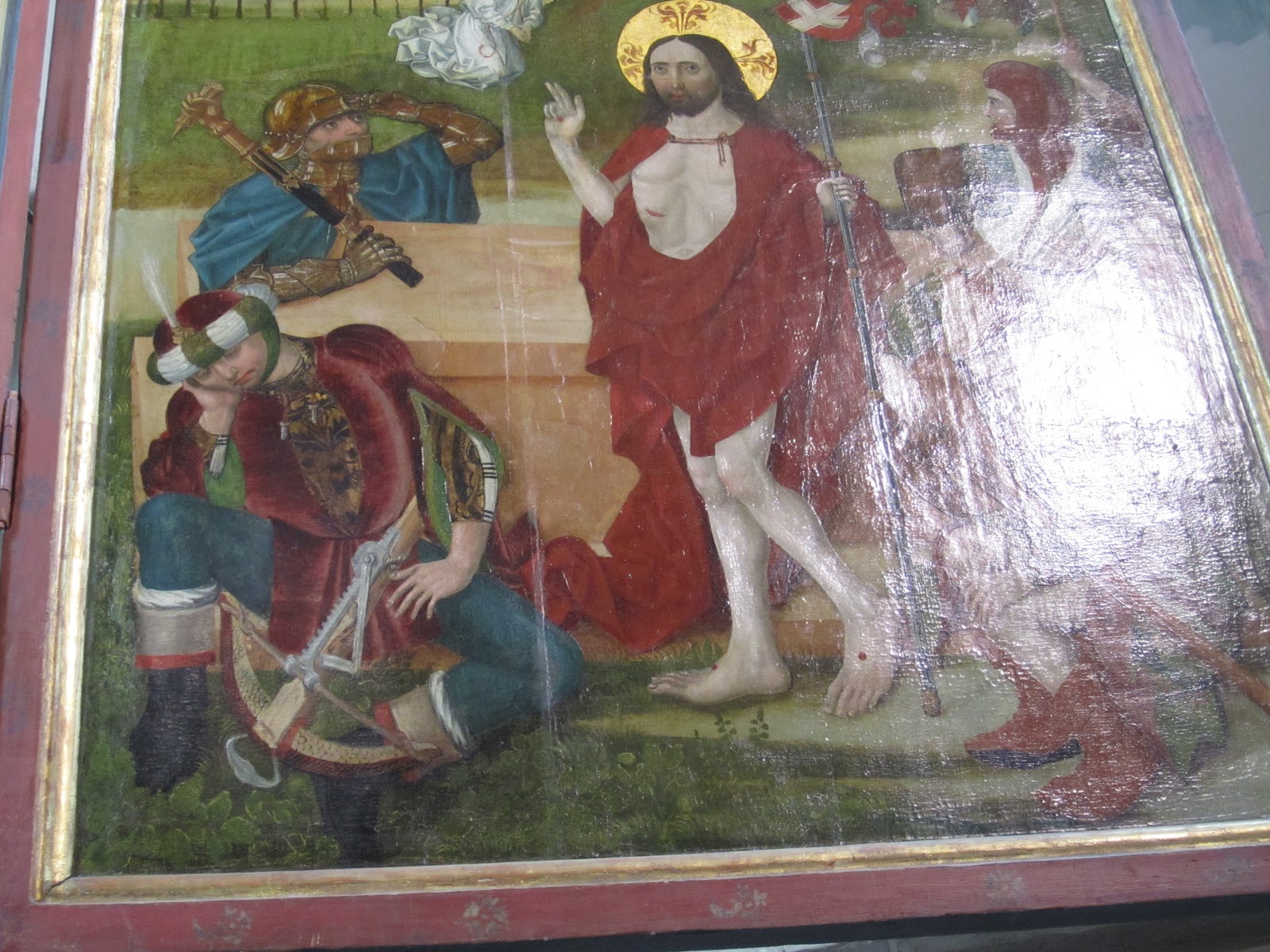
from the later fourteenth and late fifteenth centuries. The latter is another Reimenschneider carving of Konrad von Schaumberg dating from 1499. The resurrection painting, with a clear rendering of a crossbow and cranequin spanning device, as well as soldier in german style harness with an interesting hammer, is from Creglingen church.
A few more to come soon….
Subscribe to:
Posts (Atom)